Why Do Tide Times Change Every Day? The Lunar Day
Why do tide times change every day? The lunar day is 24 h 50 min, so tides run about 50 minutes later daily. Portland's NOAA predictions show the drift.
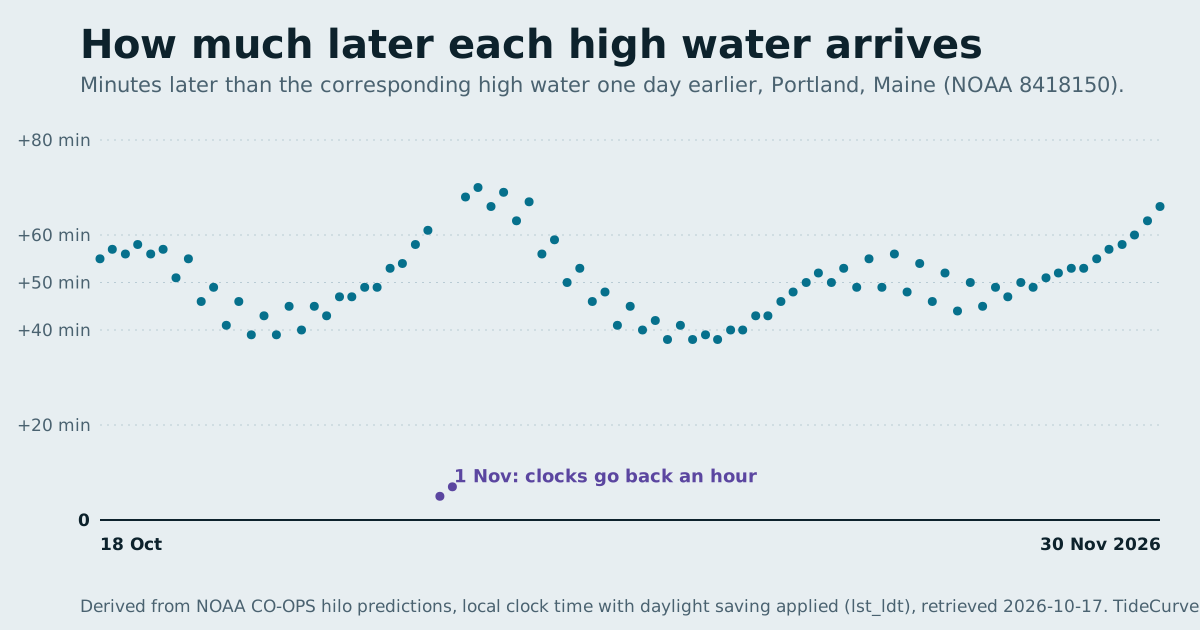
Why do tide times change every day? Because the tide keeps time with the moon, not the sun. The moon comes back to the same place over a point on Earth every 24 hours and 50 minutes, a span NOAA calls the lunar day, so each high and low water arrives roughly 50 minutes later by the clock than it did the day before. In NOAA's predictions for Portland, Maine, from 17 October to 30 November 2026, the average daily delay is 50.5 minutes, and the actual delay on a given day ranges from 38 to 70 minutes.
This guide explains where the 50 minutes come from, then measures the drift in the stored predictions for Portland and Hampton Harbor, including what happens on the morning the clocks go back.
The lunar day, in NOAA's words
NOAA's tides tutorial on the lunar day puts the core fact plainly: "Unlike a solar day, however, a lunar day is 24 hours and 50 minutes." It gives the reason in two steps: "The lunar day is 50 minutes longer than a solar day because the moon revolves around the Earth", and "So, it takes the Earth an extra 50 minutes to "catch up" to the moon."
Picture it from above. The Earth turns once a day. In that day the moon moves a little further along its orbit in the same direction. For a given harbour to line up with the moon again, the Earth has to turn that little bit further, and that takes about 50 minutes. The tide-raising pull of the moon follows the moon, so the tides follow it too.
The same tutorial adds the spacing within a day: "High tides occur 12 hours and 25 minutes apart." That is half of 24 hours 50 minutes, because the New England coast has two high waters and two low waters in each lunar day.
The sun contributes a tide as well, but it is the smaller one. NOAA's tidal harmonic constituents page describes the moon's principal term, M2, as having "2 peaks every 24-hours and 50 minutes", and the sun's principal term, S2, as having "2 peaks every 24-hours." The moon's term dominates, which is why the tide runs on lunar time.
Why do tide times change every day at Portland?
The stored predictions for Portland (NOAA 8418150) cover 45 days and 87 high waters. Two measurements show the lunar day directly.
The gap between successive high waters. Across all 86 gaps, the mean is 12 h 25 min, exactly NOAA's figure. Individual gaps range from 11 h 53 min to 12 h 54 min.
The delay from one day to the next. Comparing each high water with the corresponding high one lunar day earlier (two highs back) and subtracting 24 hours gives the daily delay. The figure at the top of the page plots it for every high water. Leaving out the two that straddle the clock change, the 83 values range from 38 to 70 minutes and average 50.5 minutes.
The first week of the stored predictions shows the drift in plain clock times:
| Date | Morning high | Later than the day before | Afternoon high | Later than the day before |
|---|---|---|---|---|
| Sat 17 Oct | 4:22 a.m. | 4:25 p.m. | ||
| Sun 18 Oct | 5:17 a.m. | 55 min | 5:22 p.m. | 57 min |
| Mon 19 Oct | 6:13 a.m. | 56 min | 6:20 p.m. | 58 min |
| Tue 20 Oct | 7:09 a.m. | 56 min | 7:17 p.m. | 57 min |
| Wed 21 Oct | 8:00 a.m. | 51 min | 8:12 p.m. | 55 min |
| Thu 22 Oct | 8:46 a.m. | 46 min | 9:01 p.m. | 49 min |
| Fri 23 Oct | 9:27 a.m. | 41 min | 9:47 p.m. | 46 min |
| Sat 24 Oct | 10:06 a.m. | 39 min | 10:30 p.m. | 43 min |
In one week the morning high moves from before dawn to mid-morning, and the afternoon high from late afternoon to late evening. That is the practical consequence of the lunar day: a tide that suits your schedule on Saturday will not suit it the following Saturday.
Why the delay is not always 50 minutes
Fifty minutes is an average, and the table above already shows the delay shrinking from 55-plus minutes to under 40 within a week. The figure shows the full pattern: the daily delay rises and falls in a wave of its own.
Over these six weeks at Portland, the shortest delays, 38 to 41 minutes, fall on 23 to 26 October and 9 to 12 November. The longest, 63 to 70 minutes, fall on 2 to 4 November, and the delay climbs past 60 minutes again by 30 November. In between it passes through the average of about 50 more than once.
It is tempting to tie that wave to a single cause, such as the moon phase, but the stored data does not support a simple rule. The short delays of 23 to 26 October and 9 to 12 November sit near the full moon of 26 October and the new moon of 9 November in the US Naval Observatory phase data stored with this site, yet around the full moon of 24 November the delay is close to average, 47 to 51 minutes. What the variation reflects is that a predicted tide is the sum of many cycles with slightly different periods; NOAA's harmonic constituents page describes the prediction as "adding the effects of each of the 37 cosine curves". Their interplay speeds up and slows down the arrival of each high water, and the average over a month lands on the lunar day. Each station has its own constituents, so the size and timing of the wave differs from place to place.
A similar spread appears at Hampton Harbor, New Hampshire (NOAA 8429489), whose stored predictions run for 182 days to April 2027. Leaving out the four high waters that straddle the two clock changes, its daily delay ranges from 31 to 73 minutes and averages 50.6 minutes. The mean gap between successive highs is again 12 h 25 min.
Days with only three tides
Because each extreme slips about 50 minutes later every day, it eventually slides past midnight and lands on the next calendar date. When that happens, one day on the tide table has only three extremes instead of four. Nothing is missing; the fourth one is just after midnight.
At Portland the stored predictions show it in the first days. Sunday 18 October has the full set: a high at 5:17 a.m., a low at 11:04 a.m., a high at 5:22 p.m. and a low at 11:52 p.m. Monday 19 October then has only three: a high at 6:13 a.m., a low at 12:01 p.m. and a high at 6:20 p.m. Its second low water, which would have been the late-evening low, has slipped to 12:47 a.m. on Tuesday 20 October.
In Portland's 45 stored days this happens six times: on 19 October, 26 October, 3 November, 10 November, 19 November and 26 November. The days alternate between ones that lose a low water and ones that lose a high water, and they come about a week apart, because a day loses one of its four extremes each time the 50-minute drift has accumulated about a quarter of a lunar day.
Across Hampton Harbor's 182 stored days, 25 have three extremes and 157 have four. The three-extreme days come roughly every week or two, alternating between days that drop a high and days that drop a low. The how to read a tide chart guide shows how that looks on a table.
What the clocks do to tide times
All times on this site are local clock time. TideCurve requests NOAA predictions with time_zone=lst_ldt, which the Data API documentation describes as "Local Standard Time, corrected for Daylight Saving Time when appropriate, local to the requested station". NIST's daylight saving time page gives the 2026 end as 1 November at 2 a.m. local time.
The figure shows the result as two outliers. On Saturday 31 October, Portland's high waters are at 3:27 a.m. and 3:39 p.m. On Sunday 1 November, after the clocks go back, they are at 3:32 a.m. and 3:46 p.m., only 5 and 7 minutes later by the clock. The tide still arrived about an hour later in real time; the clock simply moved back an hour to meet it. On 2 November the drift resumes at 68 and 70 minutes.
Hampton Harbor's stored predictions also cross the spring change. On 14 March 2027, when the clocks go forward, its high waters jump 108 and 114 minutes later by the clock than the day before: the usual drift plus the lost hour.
The lesson for reading any tide table is simple: check whether its times include daylight saving. A table in standard time is an hour early for the whole of the summer.
Using the drift to plan ahead
Once you know the tide runs about 50 minutes later each day, you can estimate roughly where it will be a few days out from a single reading, and know to check. Three practical points:
Estimate, then confirm. If high water is at 10 a.m. today, it will be early in the afternoon three days from now. That is enough to know which days to look at, not a substitute for the prediction, because the delay varies from under 40 minutes to over an hour.
Expect a week to move the tide by about six hours. Seven days of roughly 50-minute delays add up to a quarter of a day, so a morning high becomes an afternoon high a week later. Portland's stored predictions show it on successive Saturdays: high waters at 4:22 a.m. and 4:25 p.m. on 17 October, 10:06 a.m. and 10:30 p.m. on 24 October, and 3:27 a.m. and 3:39 p.m. on 31 October. The same weekend slot in consecutive weeks rarely gets the same tide.
Expect the same time of day about two weeks apart. Fourteen or fifteen days of 50-minute delays add up to roughly a full day, so a high water returns to about the same clock time after half a lunar month. That is also roughly the spacing of spring tides, which is why each run of big tides tends to peak at a similar time of day; the king tides guide shows that at Portland.
Use the station's own predictions. Timing varies along a coast: on 17 October 2026, the first high of the day is 3:58 a.m. at Eastport, 4:22 a.m. at Portland and 1:20 a.m. at Woods Hole, where the tide behaves differently enough that the stored week holds 16 high waters instead of 14.
Every station page on this site lists the coming week with dates on every table, and the printable tide chart tool will produce a month or more for any NOAA station, so the drift can be read directly rather than estimated.
What the drift does not tell you
The lunar day explains when the astronomical tide arrives. It does not account for weather. NOAA's FAQ notes that at some stations meteorological events can delay or accelerate the predicted tide by an hour or more. And like every page here, this one says nothing about whether a given tide is safe for any purpose; predicted times and heights cannot answer that.
So why do tide times change every day? Because the moon takes 24 hours and 50 minutes to come back around, and the tide follows the moon.
Sources, all retrieved 17 October 2026
- NOAA National Ocean Service, tides tutorial: the lunar day: the 24 h 50 min lunar day and 12 h 25 min between high tides.
- NOAA CO-OPS, What are harmonic constituents?: the M2 and S2 constituents.
- NOAA CO-OPS Data API documentation: the
lst_ldttime zone. - NIST, daylight saving time: 2026 dates.
- NOAA Tides and Currents FAQ: meteorological effects on timing.
- NOAA CO-OPS hilo predictions for Portland, ME (8418150), 17 October to 30 November 2026, and Hampton Harbor, NH (8429489), 17 October 2026 to 16 April 2027, local time with daylight saving applied, stored with this site. Gaps, delays and counts derived.
- US Naval Observatory moon phases, Universal Time, stored with this site in
docs/data/moon-phases-usno.json.
Frequently asked questions
Why is high tide about 50 minutes later each day?
Because the tide follows the moon, and the moon returns to the same position over a point on Earth every 24 hours and 50 minutes, not every 24 hours. NOAA explains that the moon moves along its orbit while the Earth turns, so the Earth needs an extra 50 minutes to catch up. At Portland, Maine, the average daily delay in the stored predictions is 50.5 minutes.
How many hours are there between high tides?
On a coast with two tides a day, about 12 hours 25 minutes, which is half a lunar day; NOAA's tides tutorial gives that figure. In Portland's stored predictions the mean gap between successive high waters is 12 h 25 min, but individual gaps range from 11 h 53 min to 12 h 54 min.
Is the delay always 50 minutes?
No. 50 minutes is the average. At Portland, outside the daylight saving change, the delay from one day's high to the next day's corresponding high ranges from 38 to 70 minutes in the stored predictions, rising and falling over the weeks rather than staying fixed. At Hampton Harbor, over six months, it ranges from 31 to 73 minutes.
Why are there only three tides on some days?
Because the tides keep slipping later, one extreme eventually crosses midnight into the next calendar day. At Portland that happens about every two weeks; in Hampton Harbor's 182 stored days, 25 days have three extremes and 157 have four.
What happens to tide times when the clocks change?
The predictions follow the clock. TideCurve requests NOAA times in local time with daylight saving applied, so when daylight saving ended at 2 a.m. on 1 November 2026, Portland's high waters that day came only 5 and 7 minutes later by the clock than the day before, instead of about an hour later.